
MCP 2026-07-28
MCP 2026-07-28 is the first revision without a session. Moka speaks it and the 2025 revisions, and shows which one each server uses: Settings → MCP servers shows a badge such as MCP 2026-07-28 next to the server’s name.
What changed
Section titled “What changed”| 2025-11-25 and earlier | 2026-07-28 | |
|---|---|---|
| Opening | initialize handshake, then a session | server/discover, no session; each request carries the client’s version and identity in _meta |
| Server asks the client for something (sampling, elicitation, roots) | The server sends its own request mid-call | The server answers the call with input_required; the client calls again with the answers |
| Change notifications | Sent whenever the server likes; resources/subscribe for a resource | Only on a subscriptions/listen stream the client opens |
| Tasks | In the core spec | An extension |
How sampling works now
Section titled “How sampling works now”In 2025, a tool that wanted your model sent sampling/createMessage to the client in the middle of tools/call, and waited.
In 2026-07-28 the server can’t send requests to the client. Instead:
- The client calls
tools/call brainstorm. - The server answers right away with
resultType: "input_required": “first, run this completion” (inputRequests.ideasis asampling/createMessagerequest), plus an opaquerequestState. - Moka shows you the sampling request, as before. You approve, and it runs on the workspace’s model.
- Moka calls
tools/call brainstormagain, a new request with the completion ininputResponses.ideasand the samerequestState. - The server finishes the tool and returns the result. A server can ask more than once (round 3, 4…), up to 10 rounds.
Elicitation (forms, URLs) and roots work the same way. Approval, auto-allow and deny (the server’s Sampling requests setting) are unchanged.
Sampling, roots and logging are deprecated in 2026-07-28, but stay in the spec for at least 12 months. Moka supports them in both revisions.
In the inspector
Section titled “In the inspector”| You see | Meaning |
|---|---|
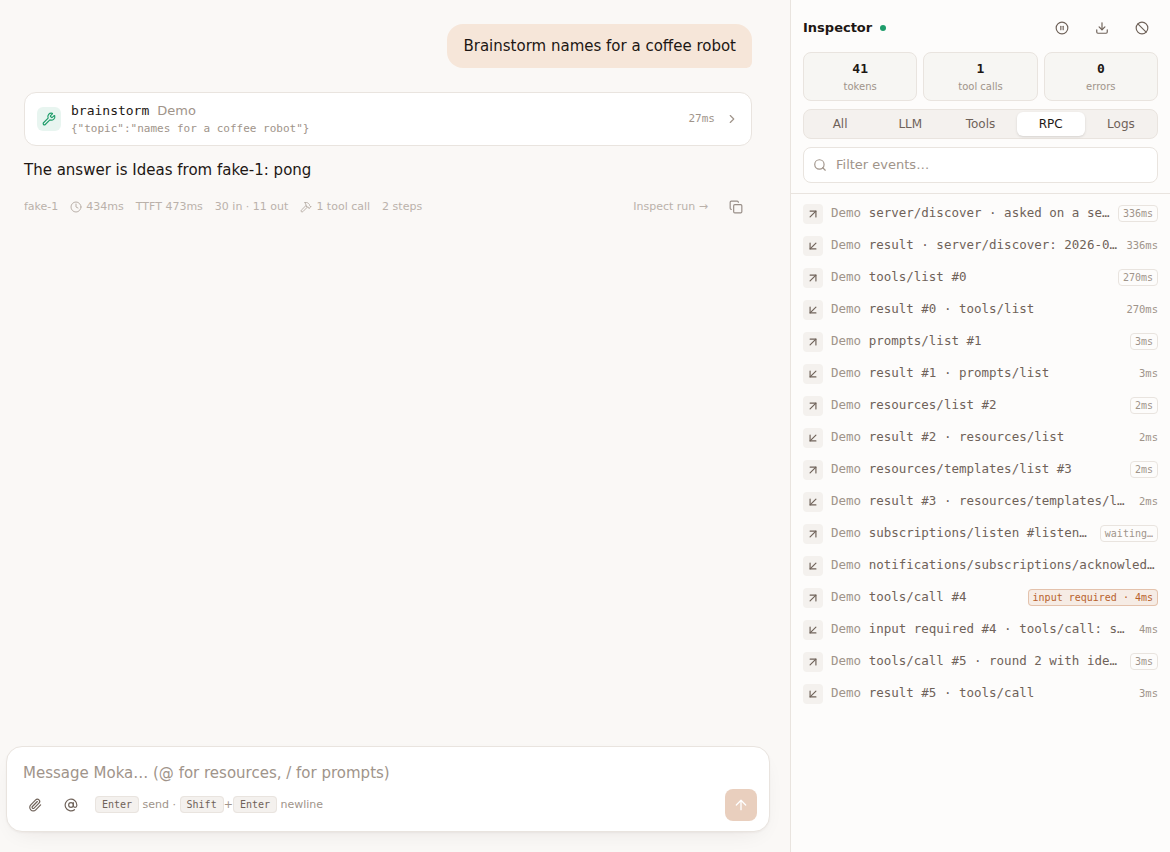
server/discover · asked on a separate copy of the server | On stdio, the SDK asks a short-lived second copy of the server which revisions it speaks, so the exchange isn’t on the session’s pipe. Moka shows it anyway |
input required badge on a request | The server needs something first; the reply lists what (sampling/createMessage, elicitation/create, roots/list) |
tools/call #5 · round 2 with ideas | The client’s retry, with the answers by key. It belongs to the same tool call (and the same attempt in Attempts) |
subscriptions/listen | The stream that carries list_changed and resources/updated. Subscribing to a resource replaces the stream with one that includes its URI |
Choosing the version
Section titled “Choosing the version”Each server has an MCP version setting (Settings → MCP servers → Advanced options), protocol in moka.json:
protocol | |
|---|---|
"auto" | Ask with server/discover; use 2026-07-28 if the server offers it, else 2025. Default for HTTP servers and the demo server |
"2025" | The classic initialize handshake. Default for stdio and SSE servers, so Moka starts each local server only once |
"2026" | 2026-07-28 only; fails if the server doesn’t offer it |
Try it
Section titled “Try it”The demo server speaks both revisions, from one codebase (TypeScript SDK v2, serveStdio). Ask “Brainstorm names for a coffee robot” or “Order me a coffee”, then open the inspector’s RPC tab. Set the demo server to 2025 to see the same tools work through sampling/createMessage and elicitation/create requests instead.
Editors behind Moka’s proxy that use 2026-07-28 are recorded the same way. The proxy view shows the version the editor asked for.