
Time-travel
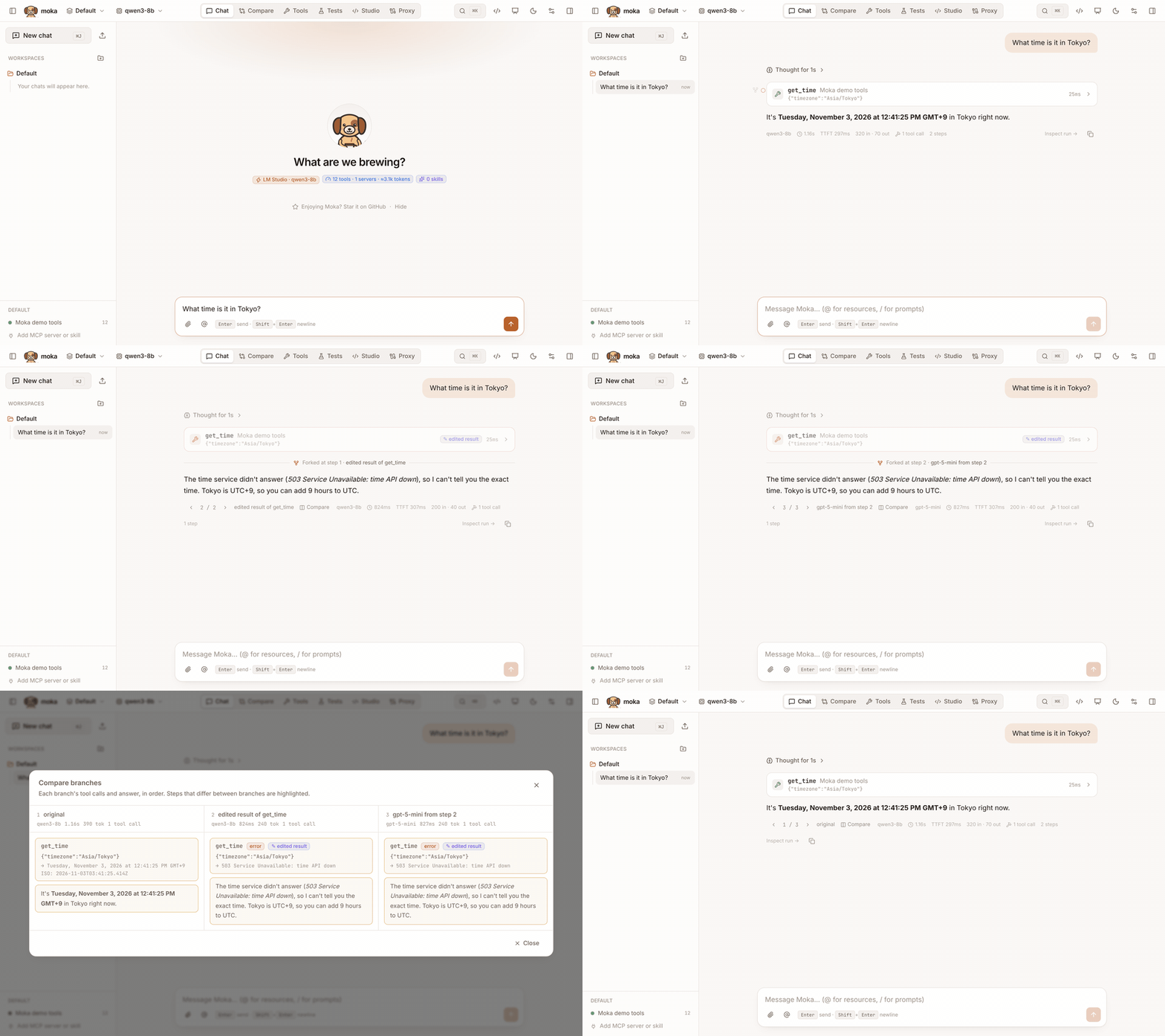
Agents go wrong a few steps in: a tool returns something odd, the model picks the wrong argument, or it gives up. Time-travel lets you go back to that step, change it, and see what happens next, without starting the conversation over.
Fork a reply
Section titled “Fork a reply”Hover any step of a reply (thinking, a tool call, or text) and click ⑂ in the margin:
| What happens | |
|---|---|
| Edit result… | The model continues as if the tool had returned your text. Tick Return it as an error to see how it copes with a failure. The tool doesn’t run again |
| Edit arguments… | Moka runs the tool again with your arguments (approvals, faults and overrides apply as usual), then the model continues |
| Edit reply… | Change the model’s text. Mid-reply, the model continues from your version; for the final answer, your version is saved as the branch |
| Retry from here | The same step again: models aren’t deterministic |
| Run from here with… | Another model takes over from this step, with the same history |
The model’s thinking can’t be edited. When you edit a reply, the thinking at that step is dropped (Claude, for one, rejects modified thinking).
Branches
Section titled “Branches”The fork streams in as a new branch of the reply. Steps it shares with the original are dimmed above a Forked at step 2 · edited result of get_time line; edited steps carry an ✎ edited badge, so nobody mistakes an edit for real model output.
- ‹ 2 / 3 › under the reply switches branch. Each branch keeps the conversation that followed it, so switching branch switches the rest of the chat too.
- Compare shows the branches side by side: each one’s tool calls (with arguments and results) and answer, in order, with steps that differ highlighted, and the time, tokens and tool calls of each.
- In the inspector, a fork’s run starts with Fork started · edited result of get_time and links to the run it came from.
Branches are saved with the chat, and survive export and import.
From the API
Section titled “From the API”A fork is a normal POST /api/chat with the history up to the fork point. When that history ends with tool calls that have no results (their arguments were edited), Moka runs them first. forkOf labels the run in the inspector:
{ "messages": [ /* up to and including the step, with the edit */ ], "llmId": "gpt-5-mini", "forkOf": { "step": 2, "edit": "model", "label": "gpt-5-mini from step 2" }}